

Africa is learning that choosing everyone may be the first step towards choosing itself
by Richard Dablah
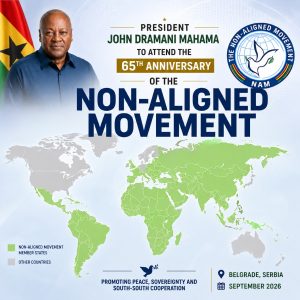 In Belgrade, the ghosts of another world are gathering. Sixty-five years after the founding of the Non-Aligned Movement, African and other Global South leaders are once again speaking the language of strategic independence. Ghanaian President John Dramani Mahama has returned to the city where the movement was born to reaffirm Ghana’s commitment to its ideals and call for a more action-oriented Non-Aligned Movement.
There is something almost theatrical about the scene. The Cold War is over. The Soviet Union disappeared more than three decades ago. The bipolar order that gave birth to non-alignment has vanished. Yet the political instinct that produced it has not.
Why? Because the world has changed without becoming less hierarchical. The old world demanded a choice between Washington and Moscow. The new world offers more choices, but perhaps no less pressure. China builds. America sanctions. Europe regulates. India negotiates. Russia arms. The Gulf invests. Turkey constructs. Everyone arrives carrying a different vocabulary of partnership. And Africa is once again being asked, sometimes explicitly and sometimes quietly, to locate itself within somebody else’s map of the world. The difference is that there are now more maps.
This is why the phrase “return of non-alignment” is both useful and misleading. Useful, because something of the original instinct has returned: the refusal to accept that African foreign policy must be organised around the preferences of great powers. Misleading, because today’s world is not divided into two rigid camps. African governments are not necessarily choosing one bloc over another. They are increasingly attempting to extract advantage from several competing centres of power.
A better word may therefore be multialignment. But even that risks missing the deeper question. Because the ability to cultivate many relationships is not the same thing as possessing power. A country can have American investors, Chinese contractors, European markets, Gulf financiers, Indian technology and Russian security cooperation and still be profoundly dependent. It may simply have diversified its dependencies.
That is the great geopolitical illusion of the multipolar age. More partners do not necessarily mean more autonomy. Sometimes they mean only more sophisticated dependence.
The distinction matters because Africa is becoming increasingly valuable to everyone. Its minerals matter to the energy transition and advanced manufacturing. Its markets matter to companies searching for new consumers. Its maritime geography matters to global shipping and security. Its population matters to the future of labour and consumption. Its political support matters in international institutions. Its cultural industries increasingly shape global taste. Its energy potential matters to a world searching for alternatives. Africa is no longer merely a strategic afterthought.
But becoming strategically valuable is not the same as becoming strategically powerful. A mine can be valuable while the country hosting it remains poor. A port can be strategically located while the surrounding economy remains disconnected from it. A large population can constitute an enormous market while producing little bargaining power if the market is fragmented. A government can possess sovereignty on paper while lacking the fiscal, technological or institutional capacity to exercise it.
This is the paradox at the heart of Africa’s geopolitical moment: the world may need Africa before Africa has acquired the power to negotiate what that need means.
That is why the revival of non-alignment should not be treated as nostalgia. It should be treated as a warning. The first generation of non-aligned leaders understood that political independence could become hollow if economic structures remained externally controlled. Kwame Nkrumah was among those who saw the problem in particularly stark terms. The end of colonial rule did not automatically end the economic relationships through which wealth, technology and strategic influence continued to flow outward. The colonial administrator could leave. The structure could remain.
Today the structure has become more complicated. The question is no longer simply who owns the mine. It is who owns the refinery. Who owns the technology. Who finances the infrastructure. Who insures the shipment. Who controls the logistics. Who provides the machinery. Who owns the intellectual property. Who determines the standards. Who captures the data. Who possesses the capacity to replace the foreign partner if political circumstances change.
Dependency has become modular. That makes it harder to see. The flag is African. The contract is African. The project is physically located in Africa. Yet the critical systems upon which the project depends may exist elsewhere.
This is sovereignty in its contemporary form: not merely the authority to govern territory, but the capacity to determine the conditions under which that territory participates in the world. That capacity is still uneven across Africa. And it explains why the continent can negotiate with powerful countries without necessarily negotiating as an equal.
Consider the language of foreign investment. Africa is repeatedly told that it must “attract capital.” The phrase sounds neutral. It is not. It establishes a psychological relationship. Africa is the destination. Capital is the chooser. Africa waits. Capital decides. The investor arrives carrying the future. The African government competes with another African government to secure the investment. Tax concessions follow. Land follows. Infrastructure follows. Regulatory exemptions may follow. And then the investment is celebrated as evidence that the country has become attractive.
But what if the question were reversed? What if Africa asked not simply “How much investment can we attract?” but “What kind of productive capacity will this investment leave behind?” That changes everything.
A billion dollars entering an economy is not automatically development. It depends on what the billion dollars does. Does it build African firms? Train African engineers? Transfer technology? Create local supply chains? Increase domestic processing? Generate intellectual property? Build export capacity? Strengthen universities? Create capabilities that remain after the foreign investor leaves? Or does it merely extract a resource, employ a limited number of workers and repatriate the bulk of the value?
The distinction is the difference between investment and accumulation. Africa has attracted investment for generations. The more difficult task is to accumulate power.
This is why the African Continental Free Trade Area may ultimately prove more geopolitically important than many foreign-policy declarations. Its significance is not simply that African goods may move more easily across borders. Its deeper significance is scale. A fragmented Africa negotiates as dozens of relatively small economies. An integrated Africa begins to possess something every major power understands: market power.
That could change the relationship between Africa and the rest of the world. The external power that wants access to African consumers would have to negotiate with a market rather than merely with individual governments. The manufacturer seeking African minerals would confront a continent increasingly capable of coordinating value chains. The technology company seeking African data would encounter stronger continental rules. The foreign investor would face a larger negotiating space.
Integration therefore becomes a geopolitical instrument. Pan-Africanism, in this sense, is not simply a cultural sentiment. It is bargaining architecture.
The problem is that Africa often possesses the rhetoric of continental power without the institutional machinery required to exercise it. The African Union has ambitious plans. Agenda 2063 explicitly seeks to reposition Africa as a global powerhouse and a stronger player in international affairs. But aspirations do not automatically create leverage.
Leverage must be built. Through payment systems. Through industrial policy. Through infrastructure. Through energy interconnection. Through research institutions. Through financial markets. Through continental supply chains. Through common negotiating positions. Through African companies capable of operating across borders. Through institutions capable of retaining expertise when governments change.
This is the less glamorous side of geopolitics. Power is built in warehouses, laboratories, ports, universities, payment systems and factories long before it appears in presidential speeches.
There is another uncomfortable truth. Africa’s external partners are not waiting passively for the continent to become stronger. They are pursuing their own strategies. China’s relationship with Africa is increasingly being discussed in terms of a more balanced strategic partnership, but analysts also acknowledge that Chinese financing and project structures can create dependencies that constrain African autonomy. The same principle applies elsewhere. America has interests. Europe has interests. India has interests. The Gulf has interests. Russia has interests.
None of this makes these relationships illegitimate. It makes them normal. The mistake would be to demand altruism from foreign powers when what Africa needs is strategy. Foreign governments are supposed to pursue their interests. African governments should do the same. The real question is whether African interests are sufficiently defined, institutionalised and defended.
This requires moving beyond the childish geopolitics of “pro-China” and “pro-West.” Such labels are intellectually convenient because they save us from analysing actual agreements. A Chinese project is not automatically good because China is not the West. An American partnership is not automatically bad because America is powerful. A European agreement is not colonialism by definition. A Russian security relationship is not liberation merely because it challenges Western influence. The passport of the partner does not determine the outcome. The structure of the bargain does.
This is where a serious African foreign policy must become almost aggressively boring. Read the contract. Calculate the debt. Trace the ownership. Follow the money. Measure technology transfer. Examine local procurement. Ask who bears the risk. Ask who owns the data. Ask who controls the infrastructure twenty years later. Ask what happens if the political relationship deteriorates. Ask what Africa can produce itself when the partnership ends. That is strategic autonomy in practice. It has little to do with speeches about sovereignty.
A state is strategically autonomous when it has alternatives. Alternatives are the physical foundation of freedom. A country that can choose between five suppliers can negotiate differently from a country dependent on one. A country with several sources of finance can negotiate differently from one facing a fiscal emergency. A country capable of processing its own minerals can negotiate differently from one that exports ore. A country capable of manufacturing critical medicines can negotiate differently during a pandemic. A country capable of producing its own digital infrastructure can negotiate differently in a technological dispute. The ability to say no is therefore not primarily diplomatic. It is economic.
This is the great lesson Africa must take from the return of non-alignment. Sovereignty is expensive. It requires redundancy. It requires domestic capability. It requires institutions. It requires savings. It requires industrial depth. It requires knowledge. It requires patience. And it requires political leaders willing to sacrifice short-term political convenience for long-term strategic capacity. That last requirement may be the hardest.
Foreign loans can finance a project today. Local capacity takes years. A foreign contractor can deliver infrastructure quickly. Building an African engineering ecosystem takes decades. A foreign technology company can solve a problem immediately. Building the domestic knowledge base to solve the next problem is slower. Politics prefers the visible. Strategy requires investment in the invisible.
This is why Africa must be careful with the language of “strategic autonomy.” It can become another slogan. India’s contemporary foreign-policy debate, for example, explicitly connects strategic autonomy with the accumulation of material capabilities rather than diplomatic rhetoric alone. That is the distinction Africa should absorb. Autonomy is not something a foreign minister declares. It is something an economy accumulates.
The return of non-alignment therefore presents Africa with a paradox. The more fragmented the world becomes, the more room African states have to manoeuvre. But the more powerful the competing external actors become, the greater the temptation to become dependent upon whichever one offers the most attractive immediate bargain. The opportunity and danger are therefore identical. Multipolarity gives Africa more choices. It also gives Africa more opportunities to make bad choices.
The answer cannot be equidistance. Africa should not stand exactly halfway between Washington and Beijing as though geopolitics were a measuring exercise. Sometimes its interests will align with one. Sometimes another. Sometimes both. Sometimes neither. The principle should be freedom of manoeuvre. Cooperate widely. Depend narrowly. Build alternatives. Negotiate collectively where collective power is greater. And never allow a partnership to become so indispensable that refusal becomes impossible.
This is where the old non-alignment must evolve. The Non-Aligned Movement of 1961 was largely concerned with political independence in a bipolar world. The African challenge of 2026 is broader. It is about economic sovereignty. Technological sovereignty. Financial sovereignty. Knowledge sovereignty. Energy sovereignty. And eventually, perhaps most importantly, the sovereignty to determine one’s own development trajectory.
That requires a different kind of non-alignment. Not non-alignment between blocs. Non-alignment between dependencies. A country should be able to trade with China without becoming dependent on China. Work with America without becoming dependent on America. Receive European capital without becoming dependent on European institutions. Welcome Gulf investment without surrendering strategic assets. Cooperate with India without becoming locked into Indian supply chains. Engage Russia without allowing security cooperation to determine the entirety of foreign policy. The objective is not to have no relationships. It is to ensure that no relationship becomes the condition of survival. That is a much harder form of independence.
And perhaps this is where Ghana’s presence in Belgrade carries significance beyond ceremony. Ghana was among the founding states of the Non-Aligned Movement. Its current president’s participation in the 65th anniversary meeting is therefore historically resonant. But history can become a trap if it merely invites nostalgia. The question Ghana and the wider continent should ask is not whether Nkrumah’s world can be reconstructed. It cannot. The question is whether the principle beneath it can be reinvented.
Nkrumah’s generation confronted a world in which political independence was threatened by external power. Our generation confronts a world in which dependence can be hidden inside infrastructure, finance, technology, supply chains, data and markets. The battlefield has moved. So must the doctrine.
Africa should therefore stop asking which great power will save it. None will. Great powers do not enter Africa to save Africa. They enter because Africa matters to their own strategies. That is not cynicism. It is international politics. The mature response is not resentment. It is bargaining.
Africa must become capable of saying: We welcome your capital, but here are our industrial conditions. We welcome your technology, but here are our ownership requirements. We welcome your security cooperation, but here are our strategic limits. We welcome your market, but here is what we need in return. We welcome your investment, but here is what must remain in Africa. That is what equal partnership sounds like when translated from diplomatic language into political economy.
And it leads to the most uncomfortable question of all. What if Africa’s greatest geopolitical problem is not that foreign powers are too powerful, but that Africa remains insufficiently powerful to make their competition work for Africans?
This changes the entire debate. The objective is no longer to defeat China. Or resist America. Or reject Europe. Or embrace Russia. Or welcome the Gulf. The objective is to make all of them negotiate. Not because Africa hates them. Because Africa has alternatives.
The first Non-Aligned Movement emerged from a generation determined not to become instruments of somebody else’s Cold War. The next African project must go further. It must ensure that Africa does not become merely the territory on which the next multipolar competition is played. It must become an actor. A market with bargaining power. A producer with technological depth. A continent with financial alternatives. A political constituency capable of collective negotiation. A knowledge system capable of defining its own priorities. A civilisation capable of engaging everyone without becoming an appendage of anyone.
Perhaps, then, the most important word in Belgrade is not non-alignment. It is choice. Because the opposite of dependence is not isolation. It is choice. And choice is not created by diplomatic declarations. It is built, slowly and sometimes painfully, through capability.
Africa does not need to belong to nobody. It needs to belong, first and decisively, to itself. That may be the real meaning of the return. Not the return of the Non-Aligned Movement as an institution. But the return of a question that the world had prematurely declared obsolete: Who gets to decide Africa’s place in the world? For centuries, others answered. The next African century will be judged by whether Africa finally does.