

by Richard DABLAH for www.eggmagazine.net
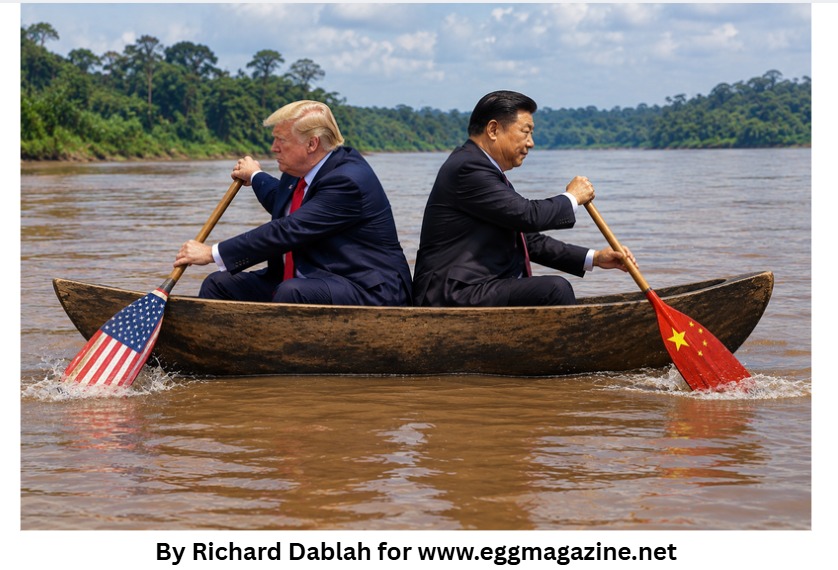
The photograph of Donald Trump and Xi Jinping leaning towards one another suggests a familiar drama: two superpowers competing for Africa’s resources. But the headline that the United States and China are competing for Congolese copper misses the deeper transformation. The contest is no longer simply over who buys Congo’s copper. It is over who can shape the infrastructure, information, finance and industrial geography through which Congolese geology becomes power.
The numbers are revealing. In July, US imports of Congolese copper reached 53,290 tonnes, giving Congo 23.9% of American copper imports. China remained the largest buyer, importing 95,778 tonnes from Congo that month. The American surge is partly commercial: Congolese cathode, not deliverable on COMEX, has been sold at substantial discounts to the US market. Yet the shift matters because copper is becoming strategic infrastructure for an electrified economy of grids, vehicles, renewables, telecommunications and data centres.
The usual language of the “resource scramble” is therefore inadequate. A scramble suggests a race for physical possession. The emerging contest is more sophisticated: *control of supply chains without necessarily controlling the mine*.
China understood this earlier. Its influence in African minerals has been built through mining, processing, infrastructure, finance and manufacturing. Washington is now trying to construct an alternative ecosystem. The Lobito Corridor, linking the Congolese and Zambian Copperbelt to Angola’s Atlantic coast, is central to that effort. A railway is also a decision about direction: which ports, markets, financiers and industrial networks a mineral economy becomes dependent upon.
This is why the most consequential news may be taking place away from the mines.
Kinshasa is building a national geological databank and tightening state control over geological information. Systematic exploration has covered barely 20% of the country, while a new programme is surveying more than 700,000 square kilometres using airborne geophysics, digitised archives and advanced analytics. The state describes the resulting data as a strategic asset.
That phrase deserves attention.
For centuries, colonial power was partly a power to map. Territory that could be surveyed, classified and measured could be administered and exploited. Today, geological intelligence performs a similar function in technological form. A geological dataset reduces exploration risk. It directs capital. It changes concession values. It identifies future deposits before they become mines. Whoever possesses superior information gains influence over where tomorrow’s extraction will occur.
Congo is therefore attempting something more consequential than resource nationalism. *It is experimenting with informational sovereignty.*
The old African demand was that foreigners should not export raw resources. The new demand should be that foreigners should not monopolise the knowledge, infrastructure and financial architecture through which those resources acquire value.
But state control over geological data can strengthen sovereignty only if access is transparent and predictable. Otherwise, the informational state merely creates another rent for insiders.
The same dilemma applies to copper processing. Congo has been moving downstream, with most of its copper already produced as refined metal, while new smelting capacity reduces dependence on concentrate exports. Yet processing alone is not industrialisation. Refining copper is not the same as manufacturing electrical equipment, cables, transformers, motors or grid components.
A country can therefore move up one rung of the value chain while remaining dependent on foreign technology, finance, machinery and markets.
Congo’s opportunity is not to choose between Washington and Beijing. *It is to make both compete for an African industrial future.*
If America wants secure copper, what will it contribute to Congolese refining, power, engineering and manufacturing? If China wants continued access to the Copperbelt, what industrial capabilities will remain in Congo? If Europe wants resilient critical-mineral supply chains, will it finance African value addition or merely seek another reliable source of imported metal?
These are questions of bargaining power.
And Congo possesses an unusual opportunity. The world increasingly needs what lies beneath its soil. Copper prices are at extraordinary levels, while US tariff policy is already rearranging global flows, pulling metal towards American warehouses even without a simple physical shortage. The scarcity is increasingly about access, location and processing capacity.
This changes the meaning of sovereignty.
Sovereignty in the mineral age is not simply legal ownership of subsoil resources. *It is the capacity to govern the chain that converts geology into economic value:* geological information, concessions, extraction, electricity, refining, transport, finance, technology and markets.
The danger is that America and China compete fiercely over Congolese minerals while Congo remains merely the terrain on which their competition occurs.
The alternative is more ambitious: make Congo the place where their competition is converted into infrastructure, knowledge, industrial capability and African ownership.
That means treating the Lobito Corridor not merely as a route for exporting copper, but as the spine of a manufacturing region. It means treating geological data as strategic national infrastructure. It means negotiating mining agreements around measurable domestic industrial obligations, not promises of investment. And it means judging every foreign partnership by one harder question:
*What productive capability remains when the mineral leaves the ground?*
The photograph of Trump and Xi therefore contains an irony. They appear to be the principal actors. Congo appears to be the object.
But the decisive question is whether Congo accepts that arrangement.
The next scramble for Africa will not necessarily be for territory. It will be for datasets, corridors, processing capacity, energy systems, offtake rights and the financial architecture that determines where value accumulates.
The mine is only the beginning.
The deeper struggle is over *who gets to draw the map between geology and power*.
For Congo, the historic opportunity is not to decide whether America or China wins its copper.
It is to ensure that *neither wins the future that its copper makes possible.