

Can an intelligent city be governed by an unintelligent state?
by Richard DABLAH for www.eggmagazine.net
Accra has never known itself better.
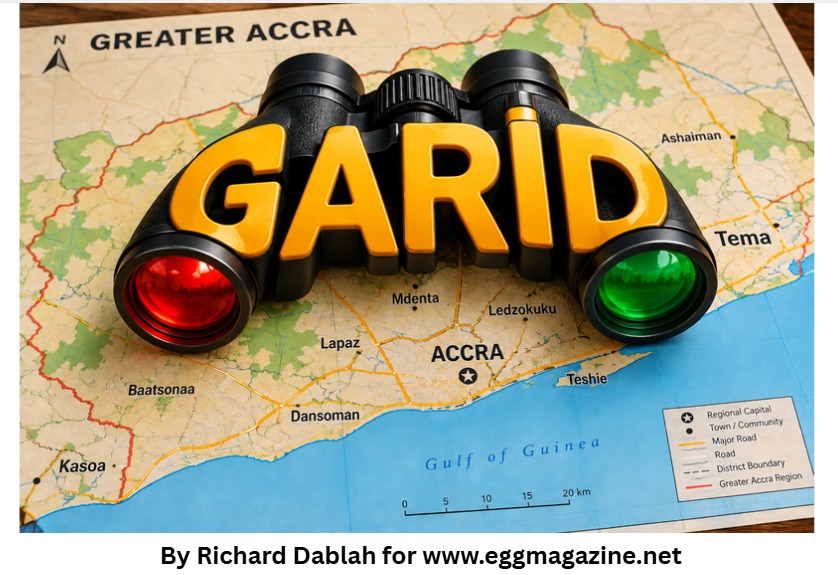 It has been mapped from above and modelled from below. Its drainage networks have been surveyed, its flood-prone communities studied, its waste flows examined and its river basin subjected to engineering analysis. Rainfall can be monitored, flood risks modelled and warnings transmitted before water reaches the streets. The city is increasingly legible to the instruments of modern governance.
Yet Accra continues to experience a peculiar contradiction: the more the city is measured, the less obvious it becomes that the state has learned how to govern what it measures.
This is the deeper question raised by the Greater Accra Resilient and Integrated Development Project, GARID.
GARID was conceived as something considerably more ambitious than a drainage programme. Its original US$200 million financing was designed to combine flood-risk management, solid-waste management, community upgrading and institutional support in the Odaw River Basin. An additional US$150 million was approved in 2023, extending the project to December 2027. The World Bank’s January 2026 assessment records nine major civil works under implementation, further works moving through contracting and design, and substantial progress on dredging and inter-jurisdictional coordination. ([World Bank][1])
The scale matters. So does the ambition.
The Odaw Basin does not conform to the administrative imagination of the state. Water does not stop at municipal boundaries. Sediment does not respect assembly jurisdictions. Waste discarded in one locality can obstruct a channel somewhere else. Development upstream can alter flood conditions downstream.
GARID therefore represents an attempt to govern a physical system rather than merely a collection of administrative territories.
That makes it an unusually revealing experiment in state capacity.
The question is no longer simply whether Ghana can construct enough drains.
It is whether Ghana can learn enough from constructing them.
An informed state possesses information. An intelligent state changes because of what it knows.
This distinction is easily missed. Modern government can accumulate extraordinary quantities of data while remaining institutionally repetitive. It can commission studies, establish committees, procure consultants, install digital systems and produce reports, yet return to the same problem with essentially the same institutional response.
The weakness in such a state is not ignorance.
It is the inability to convert knowledge into institutional memory.
GARID therefore deserves to be judged by a harder standard than the conventional language of project success or failure. Its ultimate significance lies not only in what it builds in the Odaw Basin, but in whether it changes the intellectual machinery through which Ghana governs Accra.
The first test is whether the state can see.
GARID has considerably expanded that capacity. The project approaches flooding through hydrology, drainage infrastructure, sedimentation, solid waste, spatial planning, community vulnerability and early warning. Its original design explicitly adopted a multi-programmatic approach intended to connect structural and non-structural interventions across the basin. ([World Bank][2])
This is important because every state governs according to what it makes visible.
A municipality sees a jurisdiction.
An engineer sees a hydraulic obstruction.
A sanitation authority sees waste.
A meteorologist sees rainfall.
A community sees a neighbourhood that floods.
The basin sees none of these distinctions.
It is one system.
The intellectual achievement of GARID is therefore partly geographical: it attempts to make government see the city through the logic of the watershed rather than only through the logic of the administrative map.
But seeing is not understanding.
Understanding requires diagnosis. Why does flooding persist at a particular location? Is the constraint inadequate hydraulic capacity, sediment accumulation, waste entering the drainage network, land-use change, undersized infrastructure, poor maintenance or several interacting causes?
This is where integrated governance becomes more demanding than integrated project design.
The intelligent state must distinguish symptoms from causes.
It must also anticipate.
GARID’s Flood Early Warning System points towards a different philosophy of urban governance: the state should not wait for floodwater to reveal a failure that could have been predicted earlier. Forecasting should allow institutions to intervene before the event, not merely explain it afterward.
But prediction introduces an obligation.
A warning that does not trigger an institutional response is simply information arriving early.
The real measure of intelligence is what happens between the warning and the action.
Who receives it? Who has authority to act? Which communities are alerted? Which roads are closed? Which emergency services mobilise? Which critical facilities are protected?
The technological system may generate the prediction.
Only the state can turn prediction into prevention.
And here GARID reaches its most difficult terrain: coordination.
The project has been designed around an inter-jurisdictional reality precisely because the Odaw Basin crosses administrative boundaries. The World Bank’s latest implementation assessment notes progress in establishing the Inter-Jurisdictional Coordination Management Committee, including participation agreements signed by newly appointed mayors. ([World Bank][1])
This may appear bureaucratic.
It is actually constitutional in significance.
Ghana has created institutions according to political territory. The river has created its own territory according to gravity.
The central problem of metropolitan resilience lies in the space between those two maps.
The basin is continuous.
Authority is fragmented.
GARID is therefore testing whether fragmented institutions can produce integrated action.
That test becomes particularly important when engineering meets reality. Major projects rarely proceed exactly as designed. GARID itself has encountered design adjustments, implementation delays, relocation questions and the practical difficulties of working within a densely settled urban environment. The World Bank continues to rate overall implementation as “Moderately Satisfactory” while identifying institutional capacity and sustainability as substantial risks. ([World Bank][1])
That is not evidence of failure.
It is evidence of the difference between planning and governing.
A technically sophisticated plan is not intelligence. Intelligence is the capacity to learn when reality refuses to conform to the plan.
This is why evaluation matters.
Independent research on GARID has already raised an uncomfortable but valuable finding: at the interim stage, researchers found no significant improvement in flooding conditions in targeted neighbourhoods compared with comparison areas, while several major interventions remained incomplete. At the same time, transparency and community engagement had improved.
Such findings should not be treated as an indictment.
They are precisely what a learning state needs.
A government capable of learning must be able to say: this intervention worked; this one did not; this result is premature; this assumption was wrong; this requires redesign.
Evaluation is not an accessory to governance. It is governance thinking about itself.
And then comes the final test, the one upon which all the others depend.
Memory.
What will Ghana remember when GARID ends?
The financing has a closing date. The project office will eventually disappear. Consultants will leave. Contractors will complete their assignments. Officials will be transferred. Political administrations will change.
The Odaw will remain.
This is the central paradox of externally financed development: projects have temporal boundaries, while the systems they intervene in do not.
The real question, therefore, is whether GARID can leave behind more than infrastructure.
Can it leave permanent databases, maintenance protocols, basin-management arrangements, interoperable municipal information systems, technical standards, trained institutions and decision rules that survive the project itself?
If not, Ghana may succeed in transferring infrastructure without transferring intelligence.
But if the knowledge generated through GARID becomes embedded in ordinary government, something more consequential will have occurred.
GARID will have become a school of government.
That is the standard by which I would ultimately judge it.
Not simply how many kilometres of drainage were constructed.
Not simply how much money was disbursed.
Not simply how many tonnes of sediment were removed.
But whether the Ghanaian state emerges from the project knowing Accra differently than it knew it before.
Because the deepest infrastructure problem in Accra may not be the absence of concrete.
It may be the absence of institutional memory.
And the most intelligent city is not the one surrounded by the greatest number of sensors, models and dashboards.
It is the city whose government becomes progressively less surprised by the problems it has already experienced.
GARID’s greatest possible achievement, therefore, would not be to make Accra a smarter city. It would be to make Ghana a learning state.
“`